Ski boot guides
Ski boot liners: the four types
Every ski boot liner takes the shape of your foot in one of four ways. How it does decides how closely it fits, how long it holds that fit, and what it can fix.
The liner is the soft boot inside the plastic shell. It holds your foot in place, fills the space between your foot and the shell, and keeps you warm. The shell sets the length and shape, so it has to fit your foot before any liner can help; the fit guide covers that part. This guide is about what goes inside it.
Liners differ in one main way: how they take the shape of your foot. Some are shaped at the factory for an average foot, some are heated and molded on your foot, some are foam-injected around your foot inside the shell, and some carry a cork compound that shapes itself as you wear the boot. Here is how each one works.
The four types of ski boot liner
Stock liners
The liner that comes in the boot. It is shaped at the factory for an average foot in that size, from layers of padding, and it settles and compresses as you ski. Many stock liners can be heat-molded a little at the shop, which helps at the ankle and heel. A good stock liner in a shell that fits your foot may be all you need.
Heat-moldable liners
Made from a lightweight closed-cell material that softens with heat. The liner is warmed until soft, then you put it on and stand in the boot while it cools and takes the shape of your foot. These liners are light and warm, fill volume in a roomy shell, and can usually be reheated and molded again.
Foam-injected liners
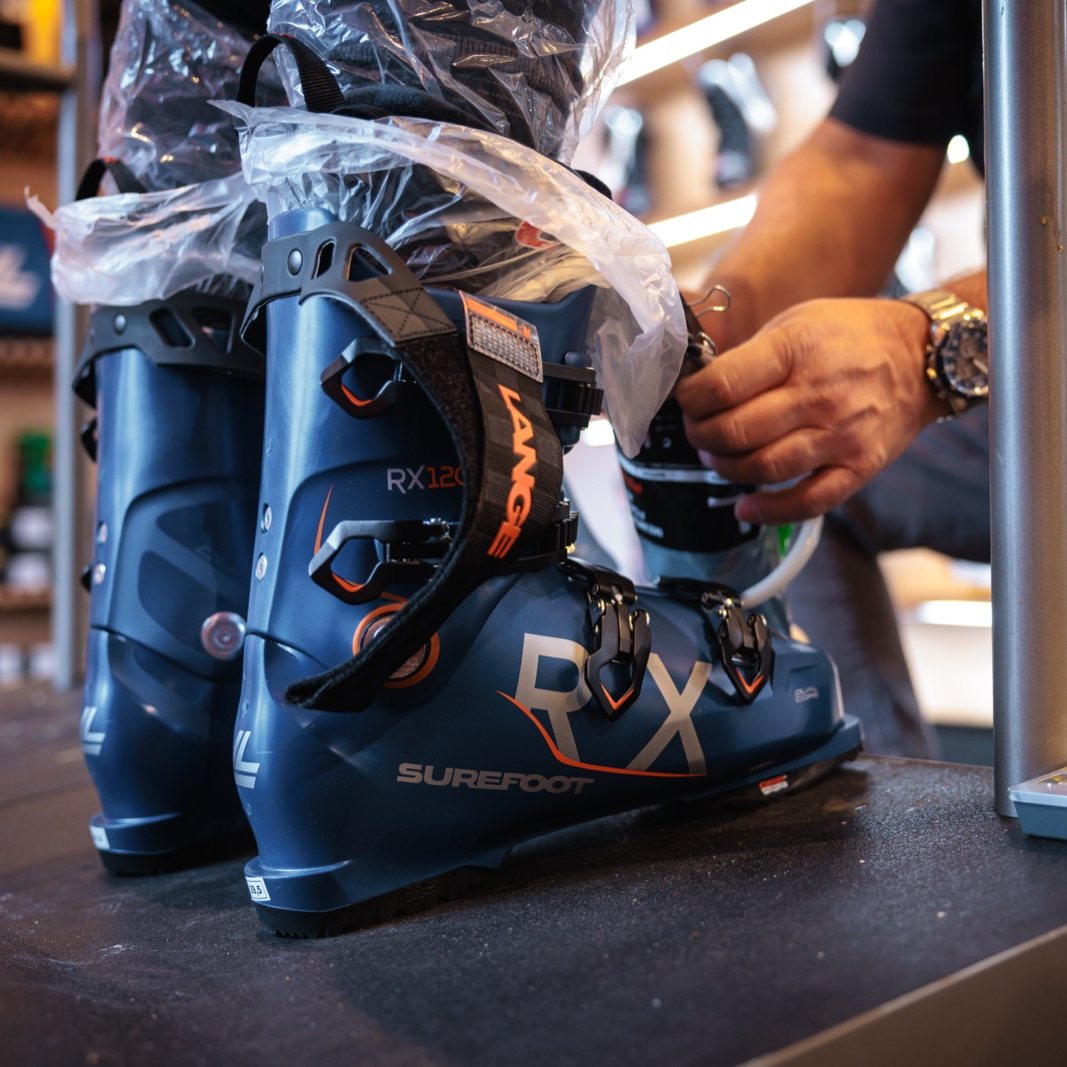
An injected liner is filled while you stand in your own boot. A fitter injects a liquid compound into the liner around your foot, and it sets into a flexible liner shaped to your foot and ankle inside the shell you will ski in, so it fills the space between your foot and that shell. Surefoot liners are made this way, with a proprietary memory compound that sets in about five minutes and needs no break-in.
Cork liners
Cork liners have pockets around the ankle, heel and tongue filled with a cork compound. It softens with the warmth of your foot and moves around the ankle as you wear the boot, and a fitter can add or remove compound to change the fit. The fit develops over several days of skiing rather than at one fitting, and the dense compound makes these liners firmer and heavier than foam liners.
The four types side by side
The same questions, asked of each type.
| Type | How it takes your shape | Adjusting it later | What to expect |
|---|---|---|---|
| Stock | Shaped at the factory for an average foot | A little: many can be heat-molded at the shop | Settles and compresses as you ski, so a close fit on day one loosens over time |
| Heat-moldable | Heated until soft, then molded on your foot as it cools | Usually: it can be reheated and molded again | Light and warm, and good at filling volume in a roomy shell; the foam can compress after many days of skiing |
| Foam-injected | Injected around your foot while you stand in the boot, and set in minutes | Your fitter fine-tunes it, and can re-inject it if adjustments aren't getting there | A close, even fit around the foot and ankle from the first run, with no break-in |
| Cork | A cork compound in pockets moves around the ankle as you wear the boot | Compound can be added or taken out | The fit builds over several days of skiing; firmer and heavier than foam |
Which liner fixes which problem?
Heel lift and a foot that slides: the answer is volume filled close to the foot. A foam-injected liner fills the space between your foot and the shell, so it is usually the fix, as long as the shell is the right length. A shell that is too long stays too long whatever goes inside it.
Cold feet: a liner that holds your foot without cranking the buckles helps most. A loose foot makes you tighten the buckles, and that squeeze restricts circulation, a common cause of cold toes. For more warmth, a liner with a heating element built in can be powered by boot heaters, and every Surefoot liner has one, ready for Winterheat ski boot heaters.
A boot that already fits: a stock liner may be all you need, and a custom liner is what a fitter recommends when the stock liner leaves room around your foot. A liner that has packed out after a few seasons is covered in the liner replacement guide.
A shell that doesn't fit your foot: no liner fixes that. Pressure on one bone is shell work, and a shell that is the wrong size needs a different shell.
How Surefoot fits a liner
Every Surefoot liner is an injected liner, fitted in one of our 29 stores. Your liner is injected with a proprietary memory compound while you stand in the boot and molded to your foot in about five minutes, then your fitter fine-tunes the fit before you leave, all in one visit. It works with all brands and models, including the boots you already own.
There are four models, the X 100, X 98, C 102 and R 92, from a slightly more relaxed fit to the narrowest race boots, and all four are $515 a pair. Every one has a heating element built in, ready for Winterheat ski boot heaters whenever you want warm feet. See the models on the custom liners page.
Fitted in store
Find the liner that fits your foot
Pick a store and a time, or walk in. Your fitter looks at your feet and your boots and recommends the liner that suits them.
Questions
What are the types of ski boot liners?
Four. Stock liners are shaped at the factory for an average foot. Heat-moldable liners are softened with heat and molded on your foot. Foam-injected liners are filled around your foot inside the shell. Cork liners carry a cork compound that shapes itself as you wear the boot.
What is the difference between heat-moldable and foam-injected liners?
A heat-moldable liner is softened with heat and molded on your foot as it cools, so it follows the outline of your foot. A foam-injected liner is filled with a compound around your foot while you stand in the shell, so it fills the space between your foot and that shell.
Do ski boot liners pack out?
Stock liners compress as you ski, which is why a boot that fit on day one can feel loose a season later. A foam-injected liner is shaped to your foot at the fitting rather than over a season, and Surefoot liners don't pack out the way factory liners do.
Can you put a new liner in any ski boot?
The liner comes out of an alpine ski boot, so most boots can take a new one. Surefoot liners work with all brands and models of ski boots, so you can keep the shell you have.
Are Surefoot liners heated?
Every Surefoot liner has a heating element built in. Add Winterheat ski boot heaters at your fitting or any time after, for ten heat levels and up to 17 hours on a charge.
How much do custom ski boot liners cost?
At Surefoot, custom liners are $515 a pair, injected and molded to your foot in store at any of our 29 locations. All four models are the same price.
Keep browsing
Ski boot guides
Ski boot liner replacement
Is a new liner the fix? The signs, the cost, and new liners in your own boots.
Custom liners
Surefoot custom liners
Four models, molded to your foot in store, $515 a pair.
Ski boot guides
How should ski boots fit?
Toes, heel, forefoot, instep and calf, and what a fitter checks.