Ski boots by fit
Ski Boots for Narrow Feet
Low-volume boots from eight brands, fitted to a scan of your foot at 29 Surefoot stores, with a custom liner and orthotic when you want them.
Narrow is a measurement, not an opinion. Every alpine shell is built on a last, the internal width across the forefoot at a size 26.5. Under about 98 millimeters is narrow, 100 is medium, 102 and up is wide. LV, the letter brands print for low volume, is not an industry standard. Lange's LV is 97 mm and Tecnica calls anything from 93 to 98 mm low volume. Read the millimeters.
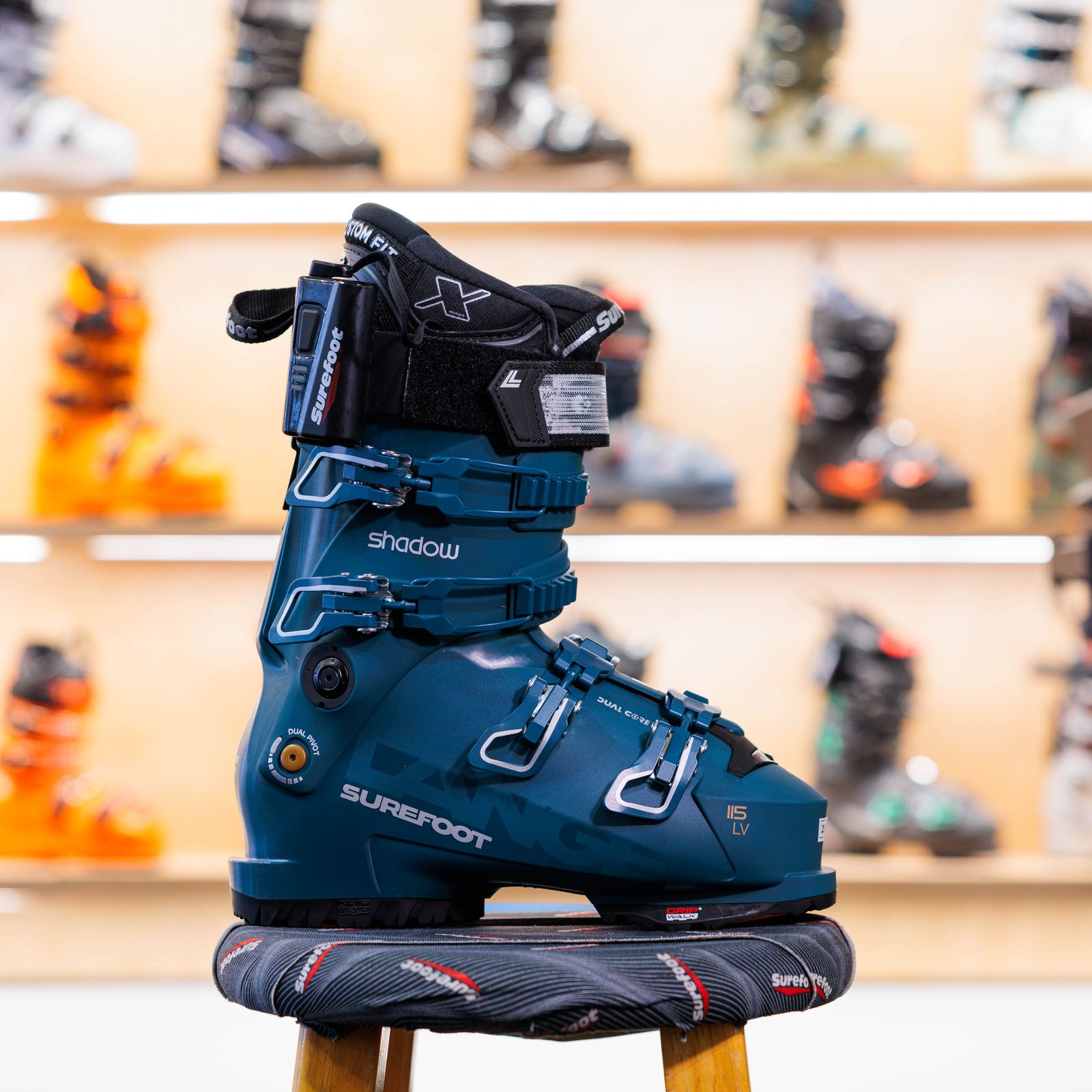
The forty boots here come from eight brands. The 96 mm race lasts are Salomon's S/Pro Race, Atomic's Redster TX and Remedy, and Head's junior Raptor WCR. At 97 mm are Lange's RS boots and the Shadow LV shells we build our own boots on. At 98 mm are the all-mountain boots most narrow-footed skiers land in: Tecnica's Mach1 LV and Mach Sport LV, Atomic's Hawx Ultra, Nordica's Promachine, Salomon's S/Pro Alpha and Head's Formula LV. Dalbello's Cabrio LV and K2's Revolve Pro are 99 mm.
A narrow foot is rarely narrow everywhere. Most skiers who swim in a boot have a low instep or a thin heel rather than thin toes, so a tight forefoot can still leave the heel floating. Every fitting therefore starts with a 3D scan of both feet, which gives length, width and arch in millimeters. If the shell alone does not hold the heel, a custom orthotic milled from the scan and a custom liner foam-injected around your foot while you stand in the shell fill the volume the plastic cannot take out. Both are options rather than requirements.
One honest note on lightweight, because the searches run together. Weight and volume are different specs. The lightest boots made are touring boots, which save grams with thinner shells and a walk mode, on lasts of every width. Atomic lists its 96 mm Remedy 130 at 2,312 grams and its wider 98 mm Hawx Ultra XTD 120 BOA at 1,860. Ask for the last width, not the weight.
Models we fit this season
Live from our catalog, every one fitted in store. Prices are for the boot as listed. A custom orthotic or Surefoot liner is optional and quoted in store; shell-only models come without a stock liner.
- Men's Cabrio LV 130 3D WRAP
- Men's Hawk Ultra 130 S Dual BOA
- Men's Hawx Ultra XTD 130 BOA
- Men's Mach1 LV 130
- Men's Remedy 130
- Men's Shadow 130 LV - Shell Only
- S/Pro Alpha 130 - Unisex
- Unisex RS 130 LV
- Men's Promachine 120
- Mach Sport 100 LV
- Revolve Pro - Kid's and Men's
- Men's Hawk Ultra 120 S BOA
- Men's Mach1 LV 120 - Shell Only
- Men's Shadow 110 LV - Shell Only
- Men's S/Pro Alpha 120
- Unisex RS 120 LV
- Men's Mach Sport LV 100
- Men's Hawk Ultra XTD 120 BOA
- Junior Racers and Women's RS 120 LV SC
- Women's Hawk Ultra XTD 115 BOA
- Women's Mach1 LV 115
- Women's Shadow 115 LV - Shell Only
- S/Pro Race 110 - Unisex
- Women's Promachine 105 - Shell Only
- Women's Formula 95 W LV - Shell Only
- Women's S/Pro Alpha 90
- Women's Mach Sport LV 85 - Shell Only
- Junior Racers and Women's RS 110 LV SC
- Women's Hawk Ultra 105 S BOA
- Mach1 LV 95 Women's
- Women's Shadow 95 LV - Shell Only
- Women's Hawk Ultra 95 BOA
- Women's Mach1 LV 95 - Shell Only
- Women's Shadow 85 LV - Shell Only
- Redster TX 110 Women's and Kid's Race
- Junior Promachine 90
- Junior RS 90 SC LV
- Kid's Raptor WCR 90
- Junior RS 70 SC LV
- Kid's Raptor WCR 70
How Surefoot fits a narrow foot
Every fitting starts with the scan and the shell. The custom orthotic and liner are there when you want them.
See the full fitting process01
Scan
A 3D scan of both feet gives your fitter length, width and arch in millimeters. It is how we choose between a 96, 97, 98 and 99 mm last instead of guessing, and how we tell a genuinely narrow foot from a low instep.
02
Custom orthotic
Optional at any fitting. Built from your scan in about 30 minutes, it holds your foot in a neutral position so the heel sits back in its pocket instead of sliding forward.
03
Custom liner
Also optional. A Surefoot liner is foam-injected around your foot while you stand in the shell, five minutes from pour to solid. It fills the volume the narrowest shell still leaves, with no break-in.
04
29 stores
Walk in or book ahead at any of our 29 stores, and bring the boots back to any Surefoot if the heel ever works loose.
Fitted in store
Book a fitting for a narrow foot
Pick a store, pick a time. A fitting with a custom liner and orthotic takes a little over an hour, and the boots go home with you the same day.
Questions
Which ski boots are narrow?
Narrow means a last under about 98 millimeters, measured across the forefoot at a size 26.5. The narrowest boots we fit are 96 mm: Salomon's S/Pro Race, Atomic's Redster TX and Remedy, and Head's junior Raptor WCR. Lange's RS and Shadow LV shells are 97 mm. At 98 mm you have Tecnica's Mach1 LV and Mach Sport LV, Atomic's Hawx Ultra, Nordica's Promachine, Salomon's S/Pro Alpha and Head's Formula LV. Dalbello's Cabrio LV and K2's Revolve Pro are 99 mm. A scan tells us which of those fits you before you try one on.
What is a low-volume ski boot?
Low volume, written LV on the boot, is a shell built narrower and shallower than the same model's standard version. It is not only the forefoot. A low-volume shell also has less room over the instep and a tighter heel pocket, which is what a thin foot needs. The letters are each brand's own rather than an industry standard. Tecnica calls 93 to 98 millimeters low volume, Lange's LV is 97 and Atomic's low-volume Hawx Ultra is 98. Read the millimeters, not the letters, and get your own feet scanned first.
How do I know if I have a narrow foot?
Most people go by how boots feel, which is unreliable, because a boot that feels loose is often too long rather than too wide. A scan settles it. Both feet are scanned in the store and your fitter reads length, width and arch in millimeters, then compares those numbers with the lasts on the wall. Width is only half of it. Instep height and heel shape decide as much as forefoot width, and plenty of skiers who describe themselves as narrow are really low volume through the instep.
My heel lifts in my ski boot, what fixes it?
Heel lift means there is more room in the boot than there is foot, usually above the instep and behind the ankle. Cranking the buckles does not fix it and it makes your feet cold. Two things do. A custom orthotic holds the foot in a neutral position so the heel sits back in its pocket instead of sliding forward. A custom liner is then foam-injected around your foot while you stand in the shell, filling the space a stock liner leaves. That is volume the plastic cannot remove, and it is what stops the lift.
Are lightweight ski boots narrow?
Not necessarily. Weight and volume are different measurements. Lightweight boots save grams with thinner shells and a walk mode, and they are built on lasts of every width, so a light boot can be a wide boot. Race boots go the other way. They use the narrowest lasts and dense polyurethane shells, and they are not light. Atomic's own specs put the 96 mm Remedy 130 at 2,312 grams and the wider 98 mm Hawx Ultra XTD 120 BOA at 1,860. If your foot is swimming, ask for the last width.
Do you sell ski boots online?
No. Ski boots and liners are fitted in store only. The shell has to be chosen on your foot, and a custom liner or orthotic, if you add one, is built the same day. That matters more for a narrow foot than for anyone else, because the fit is decided in millimeters. Browse the models here, then book a fitting at any of our 29 stores. If the store does not have the model you want, we will track it down.