Ski boot guides
Ski Boot Last Width
Last is the internal width of the shell across your forefoot, in millimeters, and it is the number that decides whether a boot fits before anything else does.
What is the last on a ski boot?
The last is the internal width of the shell across the forefoot, measured over the five metatarsals at the widest point of the foot. It is printed in millimeters, and every brand quotes it for one shell size, a 26.5. That is the whole convention: when Atomic says a boot is 100 mm, it means 100 mm across the forefoot of a 26.5 shell.
The useful range runs from about 96 mm, which is race width, to 104 mm, which is the widest boot we fit. Below is every alpine line we fit and a few we do not, at the width its own maker states.
Ski boot last widths, brand by brand
Every width is the manufacturer's own figure for a size 26.5 shell, with the label that maker puts on it.
| Width at 26.5 | Lines at that width | Usually called |
|---|---|---|
| 96 mm | Salomon S/Pro Race · Atomic Redster TX and Remedy · Head Raptor WCR | Race, narrow |
| 97 mm | Lange RS · Lange Shadow LV | Low volume (LV) |
| 98 mm | Atomic Hawx Ultra · Tecnica Mach1 LV and Mach Sport LV · Nordica Promachine · Salomon S/Pro Alpha · Head Formula LV · K2 Cortex | Low volume (LV) |
| 99 mm | Tecnica Cochise · Dalbello Cabrio LV · K2 FL3X Revolve Pro · Nordica Unlimited | Low to medium volume |
| 100 mm | Salomon S/Pro Supra · Atomic Hawx Prime · Lange Shadow MV and RS MV · Tecnica Mach BOA MV · Nordica Speedmachine 3 · Head Kore and Kaliber · K2 Recon, Anthem and Mindbender | Medium volume (MV) |
| 101 mm | Dalbello Cabrio MV | Medium volume (MV) |
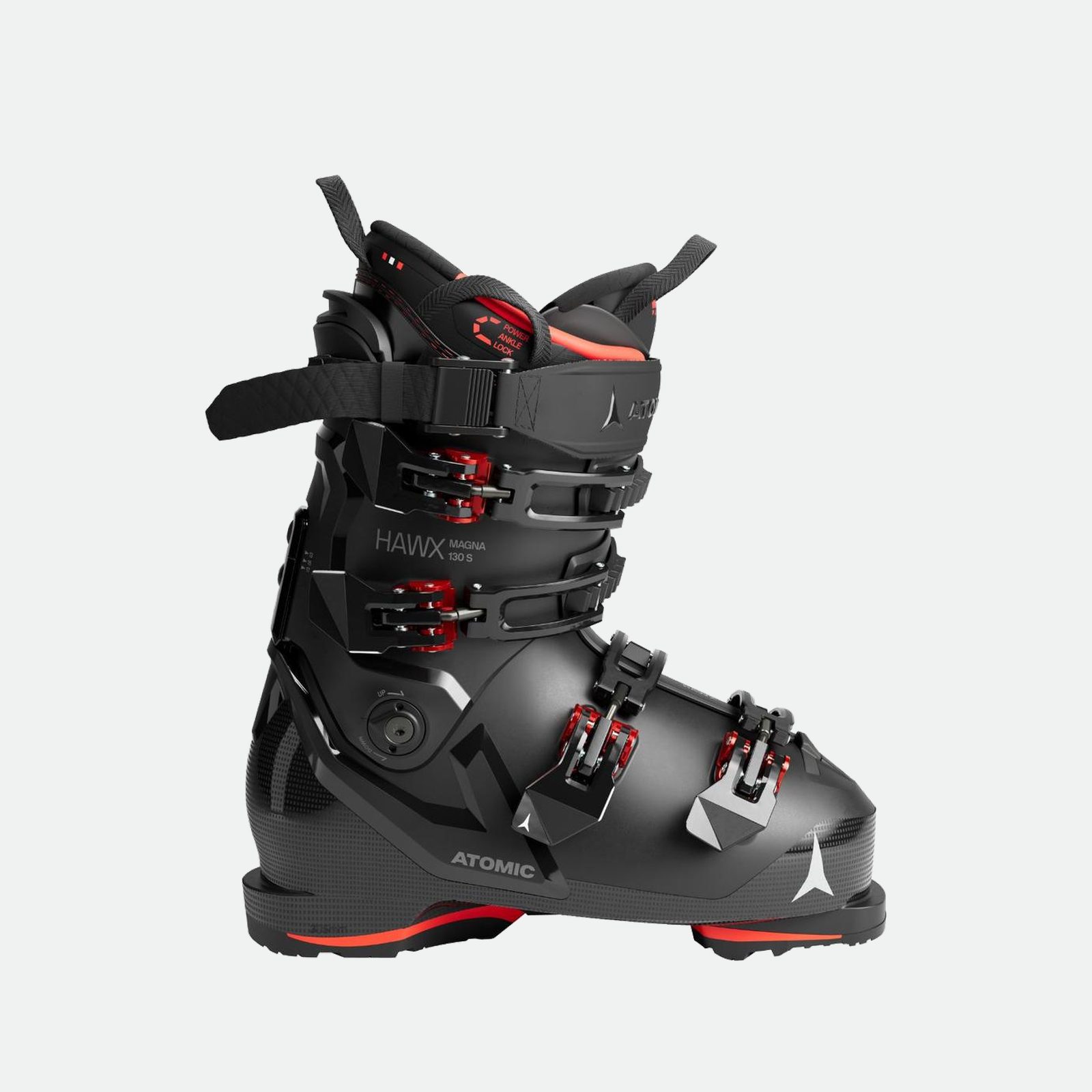
| 102 mm | Atomic Hawx Magna · Lange Shadow HV · Nordica Sportmachine 3 and HF · Tecnica Cochise HV · Head Edge · K2 FL3X Method | High volume (HV), Nordica says medium wide |
| 103 mm | Tecnica Mach1 HV and Mach BOA HV · Lange Concept BOA · K2 BFC | High volume (HV), Lange says comfort volume |
| 104 mm | Nordica Cruise | Wide |
Every width here is the manufacturer's own figure for a size 26.5 shell. The same model runs about 2 to 2.5 millimeters wider or narrower for every full size, and the brands do not agree on the figure. The letters do not travel: Dalbello's LV is 99 mm, Lange's is 97, and Nordica calls 102 mm "medium wide" while Lange calls 103 mm "comfort volume".
What do LV, MV and HV mean?
Low volume, medium volume and high volume, and they are not an industry standard. They are each brand's own shorthand, and the millimeters behind them move.
Our own working ranges are 97 to 98 mm for low volume, 99 to 100 for medium and 102 to 104 for high. Other fitters draw the lines a millimeter or two either side. The brands are further apart than that. Lange's LV is 97 mm and Dalbello's LV is 99, which is what another brand calls medium. Tecnica calls anything from 93 to 98 mm low volume. Nordica labels its 102 mm boots "medium wide" and saves the word "wide" for the 104 mm Cruise. Lange calls its 103 mm Concept last "comfort volume".
So the letters are a starting point and the number is the answer. If a boot is described to you as low volume, ask what it measures.
Why does the same 100 mm boot fit differently in a different size?
Because the width is quoted at 26.5 and it scales with the shell. Atomic publishes the ladder for its own boots: the Hawx Magna it markets as 102 mm measures 100 mm at a size 25, 104 at a 27, 106 at a 28 and 110 at a 30. That is about 2 millimeters per full size. Nordica's fit manual puts the average at 2.5 mm.
Two things follow, and they catch people out constantly. A 102 mm boot in a 29.5 is a wider boot than a 104 mm boot in a 25.5. And if your feet are small, the "wide" boots you have been reading about are narrower than their label suggests, while if your feet are large, the narrow ones are wider. The label describes a size you may not wear. The sizing guide covers the size side of that.
Last, volume and instep are three different things
Width is one measurement of a three-dimensional space. Two shells can both measure 100 mm and feel nothing alike, because the heel pocket, the ankle, the instep and the wall above the arch are all shaped differently. A low-volume shell is not only narrower, it is shallower over the instep and tighter at the heel, which is what a thin foot actually needs.
Instep height is the one people miss. A foot can be narrow across the forefoot and still be tall through the middle, and that foot will fight a low-volume shell it measures into. Three-piece boots such as Dalbello's Cabrio and K2's FL3X line answer that with more floor-to-ceiling height over the instep, so the plastic does not close down on top of the foot when you shut the buckle. It is a shape difference, not a width difference, and no chart shows it.
Why a narrow foot in a wide boot is the common mistake
Buying wide to be safe is the most expensive error in a boot shop. The closer your foot sits to the plastic, the better the boot works, which is why racers ski lasts as narrow as 92 mm on feet that measure wider.
A foot with room around it moves, and a foot that moves gets held down harder to stop it, which is how skiers end up cranking buckles and losing circulation and feeling by lunchtime. Worse, a loose fit can imitate a tight one. If the arch collapses inside the boot it presses into the wall above the arch and pushes the foot outward, and the boot then feels too narrow even though the number was right. A low instep does the same thing by letting the foot slide forward into the narrower front of the shell. And a boot that feels loose is very often too long rather than too wide.
Wider shells also tend to be less anatomical inside. A 97 mm shell is shaped closer to the outline of a foot than a 104 mm one, which has to accommodate more shapes with the same plastic. The narrow-feet and wide-feet pages list the boots at each end.
What is BSL, and is it my boot size?
BSL is boot sole length: the length of the boot's outer sole, in millimeters. It is not your size and it is not your foot length. It is a measurement of the boot.
Every manufacturer publishes it for every size. Atomic lists 305 mm for a 26 or 26.5 shell, 315 for a 27, 325 for a 28, and so on in 10 mm steps. Notice that two mondopoint sizes share one number, because they share one shell: a 26 and a 26.5 are the same piece of plastic with a different liner.
It matters because the boot is the binding's other half. The boot-to-binding interface is set by a standard, ISO 5355, which fixes the shape of the hard plastic flanges at the toe and heel, and rockered walking soles have their own standard, ISO 23223, better known as GripWalk. So the sole length and the sole type are both things your skis need to know about, and a new pair of boots is a reason to have your bindings looked at even when the mondopoint size has not changed.
How Surefoot picks a last
Every fitting starts with a 3D scan of both feet, which gives your fitter length, width and arch height in millimeters, so the shell is chosen from your numbers rather than from a chart or from how a boot feels in the first five minutes. From there, a custom orthotic milled from your scan and a custom liner foam-injected around your foot inside the shell are both options rather than requirements, and both change what a given last can hold. A fitting with the liner and orthotic takes a little over an hour and the boots go home with you the same day, at any of our 29 stores.
Fitted in store
Fitted to the number, not the label
Pick a store, pick a time. A fitting with a custom liner and orthotic takes a little over an hour, and the boots go home with you the same day.
Questions
What is the last on a ski boot?
The last is the internal width of the shell across the forefoot, measured at the widest part of the foot over the five metatarsals. It is given in millimeters and always for one reference shell size, a 26.5. Race boots start around 96 mm and the widest boots we fit are 104 mm. The number describes the plastic, not your foot, and two boots with the same last can still be shaped differently inside at the heel, ankle and instep.
What do LV, MV and HV mean on ski boots?
Low volume, medium volume and high volume. They are each brand's own labels rather than an industry standard, so the millimeters behind them move. We treat 97 to 98 mm as low volume, 99 to 100 as medium and 102 to 104 as high. Lange's LV is 97 mm, Dalbello's LV is 99, and Tecnica calls anything from 93 to 98 low volume. Nordica calls its 102 mm boots medium wide. Read the number, not the letters.
What last width do I need for wide feet?
Most skiers who call their feet wide land at 102 mm or above, which is where the Atomic Hawx Magna, Lange Shadow HV, Nordica Sportmachine and HF, Tecnica Cochise HV, Tecnica Mach1 HV and Nordica Cruise sit. But width alone will not tell you. Instep height and heel shape decide as much, and a scan measures all of it in millimeters before you try anything on. A wide shell can also be stretched in one spot where a foot needs the room.
Is a 100 mm last the same width in every size?
No. The figure is quoted for a size 26.5 shell and it scales with the shell. Atomic publishes its own ladder: the boot it markets as 102 mm measures 100 mm at a size 25 and 106 at a size 28. Nordica puts the average change at 2.5 mm per full size and other sources say 2 mm. Either way, a wide boot in a small size can be narrower than a narrow boot in a large one, so compare boots at your own size.
What does BSL mean on a ski boot?
BSL is boot sole length, the length of the boot's outer sole in millimeters. It is a measurement of the boot, not a size and not your foot length. Manufacturers publish it for every size. Atomic lists 305 mm for a 26 or 26.5 shell and 315 mm for a 27, stepping 10 mm per full size. Two mondopoint sizes share one number because they share one shell. Your bindings are matched to the boot, so the sole length and the sole type both matter.
Can a ski boot be too wide?
Yes, and it is the more common mistake. The closer your foot sits to the plastic, the better the boot holds and steers. A foot with space around it slides, and skiers respond by tightening buckles, which is how feet go cold and numb. A loose boot can even feel tight: if the arch drops inside the shell it pushes the foot outward against the wall above the arch, and a boot that measured correctly starts to feel narrow.
How do I find out my own foot width?
Get both feet scanned rather than guessing from a shoe size, because street shoes are sized by length and sold in half sizes that a ski shell does not have. At Surefoot every fitting begins with a 3D scan of both feet that reads length, width and arch height in millimeters, and your fitter compares those numbers against the lasts on the wall. Feet also differ from each other, and the scan shows that before a boot ever goes on.