Ski boot guides
How should ski boots fit?
Snug everywhere, tight nowhere, and held at the heel. Here is what that means at each part of the foot, and how a fitter checks it.
A ski boot should feel like a firm handshake around the whole foot: even contact everywhere, pressure nowhere, and a heel that stays put when you flex forward. Standing tall, your toes brush the front of the liner. Bend your knees into the cuff and they pull back off it. That is snug. Numb toes, a hot spot on one bone, or a heel that lifts in every turn is not snug. It is a fit problem, and each one points at a different part of the boot.
This guide takes the boot one place at a time: toes, heel, forefoot, instep and calf. It then covers how a fitter checks a fit with the liner out of the shell, why a boot can feel loose for two opposite reasons, what heel lift means, and where socks, footbeds and liners come in. Length has its own guide, and so does width.
The five places a boot has to fit
Five separate measurements. A boot can be right on four of them and wrong on one, and the wrong one is what you feel.
Toes
Standing upright in a buckled boot, your toes should touch or brush the front of the liner. When you flex into the cuff, the heel drives back into its pocket and the toes come off the front. Toes that never touch mean a boot that is long. Toes that stay jammed when you flex point at a boot that is short, or a heel that is not being held.
Heel
The heel is the anchor. It should sit down in the pocket at the back of the boot and stay there when you flex, with no lift and no side to side movement. Bootfitting guides treat the zone around the ankle and instep as the most critical fit area in the boot, because a heel that is held is what lets the rest of the boot be comfortable.
Forefoot
Across the ball of the foot you want firm, even contact and no single point of pressure. This is the one dimension a boot's published last width describes, in millimeters at a reference size, and it is only the forefoot. The last-width guide covers what 98, 100 and 102 mm mean.
Instep
The instep is the top of the foot. A boot can be wide enough across the forefoot and still clamp down here, and pressure over the instep is one of the harder problems to fix afterwards, which is why a fitter measures it first. It is separate from width: a narrow heel with a high instep is common, and so is the reverse.
Calf
The cuff has to close around your lower leg without forcing it. A low or heavy calf can stop the cuff closing, and the answer is a cuff that matches the leg, not a longer shell. Women's boots are generally built with a lower cuff. Wide calves and high insteps get their own section on the wide-feet page.
Snug, or a problem? How to tell
New boots feel tighter than the pair you have skied for five winters, and that is expected. A stock liner softens and compresses with use, so a boot fitted to feel roomy in the shop is a boot that is loose by February. Firm, even pressure that fades as you ski is snug. Pressure that grows, that sits on one spot, or that sends a toe numb is a fit problem.
The usual signs, and what they point at. Toes numb or cold after a few runs: a boot that is too long and buckled hard to make up for it, or too tight over the instep. A hot spot on the ankle bone or the side of the foot: a shell that needs room in one place. Soreness at the top of the shin: a cuff that does not match the leg, or a flex that is wrong for the skier. A heel that lifts in every turn: a boot that is too long or too big in volume. None of these is something to ski through. They are what a fitter fixes, and the sooner the boot comes back the smaller the fix.
What the shell check examines
A fitter checks length with the liner out. You stand in the bare shell in a ski sock, slide your foot forward until your toes touch the front, and the fitter measures the space behind your heel. Published bootfitting guidance puts it at roughly one to two fingers, about 15 to 20 millimeters, and tighter for stronger skiers. The same check shows volume: with the foot centered in the shell, the fitter looks at the room either side of the forefoot and over the instep.
It answers whether the shell is the right length and volume before the liner, the footbed or anything else gets a say, which is why it comes first. The sizing guide covers the length half in detail, and the size chart gets you to the right rows before you arrive.
Why a boot feels loose
Two opposite problems feel the same from inside a boot. A boot that is too long lets the foot slide forward until the toes hit, and the heel lifts on the way. A boot that is the right length but too big in volume, too wide or too tall over the instep, lets the foot move sideways and up, and the heel lifts too. Skiers meet both by cranking the buckles, which pins the foot, squeezes it, and makes cold toes worse.
The shell check separates the two. Length is fixed by a different shell, full stop. Volume around the right length can often be filled inside the shell, with a supportive footbed and a liner shaped to the foot. That is the order a fitting runs in: shell first, then what goes in it. A boot that is too wide and a boot that is too narrow each have a page of their own.
Heel lift: movement in the boot, or a wedge under the heel
The phrase means two things. To most skiers, heel lift is the heel rising out of its pocket when they flex forward, and it is the most common fit complaint there is. A little movement inside a stock liner is normal. A heel that visibly rises in every turn is not: it means the boot is too long, too big in volume, or the liner has compressed, and a fitter tells those apart with the liner out.
A heel lift is also a thin wedge a bootfitter can place under the heel, inside the boot, to change the angle of the ankle. That is a stance adjustment for a boot that already fits. It is not a way to make a long boot hold the heel, and it is not something to add at home to a boot that feels loose.
Socks, footbeds and liners
Socks, footbeds and liners work together inside the shell. Start with one thin, ski-specific pair of socks. A thick sock takes up room the boot was fitted without and changes the fit. Surefoot's own ski socks are made for this layer: the Vapor Peaks is a merino blend with an ultralight fit, the Vapor Plus adds cushioning at the heel, toe and shin, and there is a kids sock. Your fitter can help you choose the right sock for your boots, then check the fit with it on.
Footbeds: the flat insole a boot ships with does very little. A supportive footbed, or a custom orthotic milled from a scan of your foot, holds the foot in a neutral position so it does not spread and slide inside the shell.
Liners: a stock liner is built for an average foot in that size, so it can leave gaps at the heel and ankle that a stock foot does not have. A foam-injected custom liner is shaped around your foot inside your own shell, filling the space a stock liner leaves and setting the fit at the fitting rather than over a season. At Surefoot the scan and the shell come first. Custom orthotics and liners are options your fitter will discuss as part of finding the right setup for your feet.
What a fitting includes, and what to bring
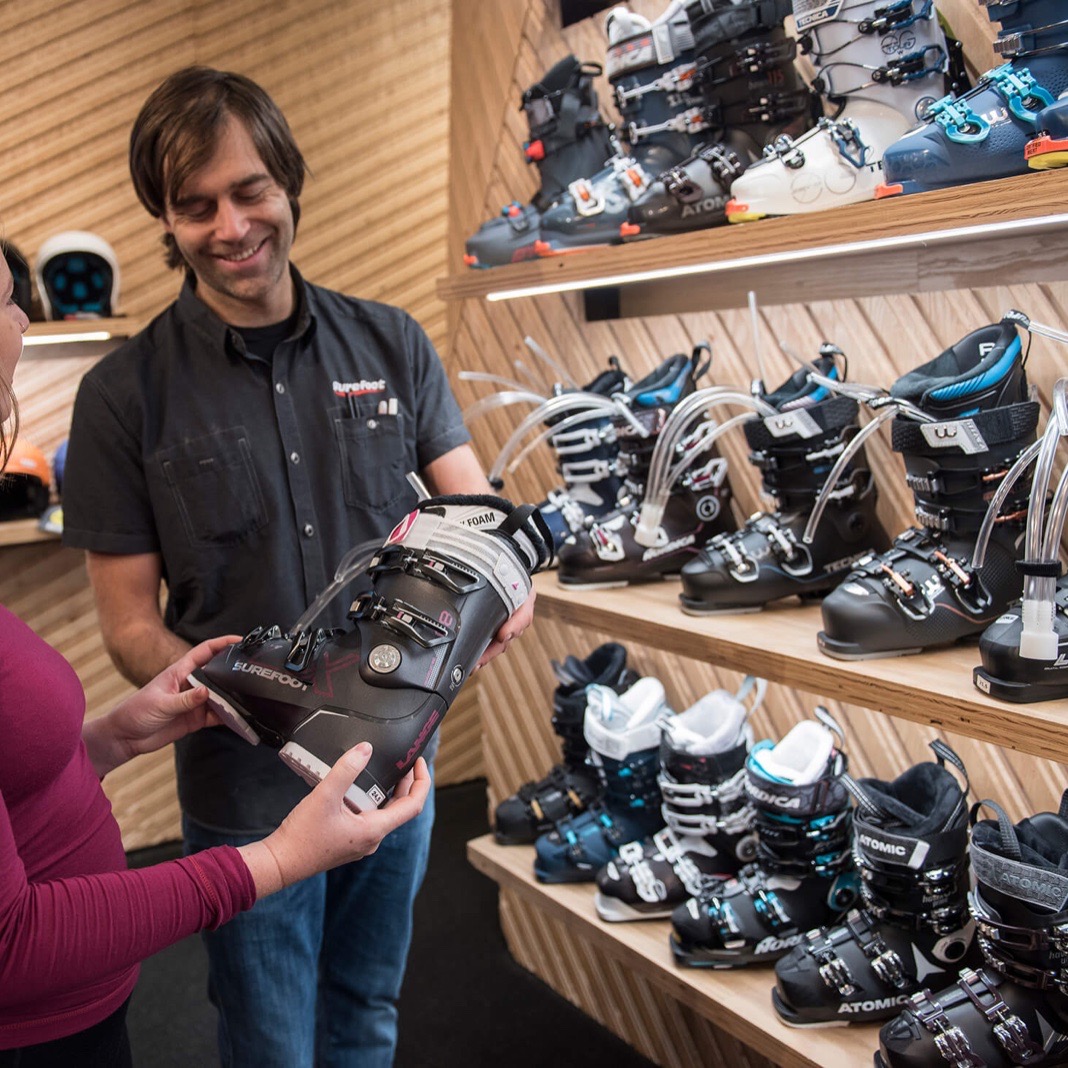
A Surefoot fitting starts with a 3D scan of both feet, which gives your fitter length, width and arch in millimeters. The shell is chosen on your foot from more than 100 models across every major brand and checked with the liner out. Your fitter then considers the full setup, including a custom orthotic milled from your scan and a liner foam-injected around your foot. A full fitting takes a little over an hour and the boots go home with you the same day.
Bring your current boots and footbeds if you have them, so the fitter can see what has and has not worked. We carry Surefoot ski socks in store and can help you choose a pair for your setup. If the fit changes later, bring the boots back to any of our 29 stores.
Fitted in store
Have the fit checked on your foot
Pick a store, pick a time. A fitting with a custom liner and orthotic takes a little over an hour, and the boots go home with you the same day.
Questions
How tight should ski boots be?
Snug over the whole foot, with your toes brushing the front when you stand tall and pulling off it when you flex, the heel held down, and no single point of pressure. Tighter than a shoe, never painful. If you have to crank the buckles to feel held, the boot is the wrong length or volume rather than the wrong tightness.
Should my toes touch the front of my ski boots?
Standing upright, yes, lightly. Flex forward into the cuff and they should come off the front. Toes that never touch mean the boot is long. Toes that stay jammed when you flex mean the boot is short, or the heel is not being held in its pocket.
How much heel lift is normal in a ski boot?
A little movement inside a stock liner is normal. A heel that visibly rises out of its pocket in every turn is not: it means the boot is too long, too big in volume, or the liner has compressed. The fix depends on which, and a fitter tells them apart with the liner out of the shell.
Do ski boots loosen up over time?
Stock liners soften and compress with use, so a boot fitted to feel roomy on day one is loose by mid-season. That is why a fitter sets a new boot snug rather than comfortable in the shop. A foam-injected liner is shaped to the foot at the fitting instead of over a season of skiing.
Are ski boots supposed to hurt?
No. Firm, even pressure is right. Pain in one spot, numb toes or a sore shin is a fit problem, and each one points at a specific part of the boot. Bring the boot back to a fitter rather than skiing through it. A fitter can usually work on the specific spot rather than the whole boot.
Why do my feet get cold in ski boots?
Usually the boot, not the weather. A boot that is too long or too big in volume gets buckled hard to hold the foot, and that squeeze is what makes toes cold. Thick socks make it worse by taking up room. The fix is a boot that holds the foot without being cranked down. For genuinely cold days there are heated liners and boot heaters, but they do not fix a fit.
Can a ski boot that is too big be fixed?
Partly. Extra volume around the right length can often be filled with a supportive footbed and a liner shaped to the foot. Extra length cannot. A shell that is too long stays too long whatever goes inside it, which is why the shell check comes before anything else at a fitting.
Do you sell ski boots online?
No. Ski boots and liners are fitted in store only, because the shell has to be chosen and checked on your foot. Browse the brand and fit pages here, then book a fitting at any of our 29 stores.
Keep browsing
Ski boot guides
Choosing a footbed
Compare stock, pre-molded and custom ski boot insoles.
Ski boot guides
Ski boot size chart
Nordica's chart for men, women and kids, a converter, and the shell check.
Ski boot guides
Ski boot last and width
What 96, 98, 100 and 104 mm mean, and which brands sit where.
How it works
The fitting process
Scan, shell, orthotic, liner: the four steps, start to finish.