Ski boot guides
Ski Boot Flex
What the number on the cuff means, what flex to start from, and why a 120 in one brand is not a 120 in another.
What does the flex number on a ski boot mean?
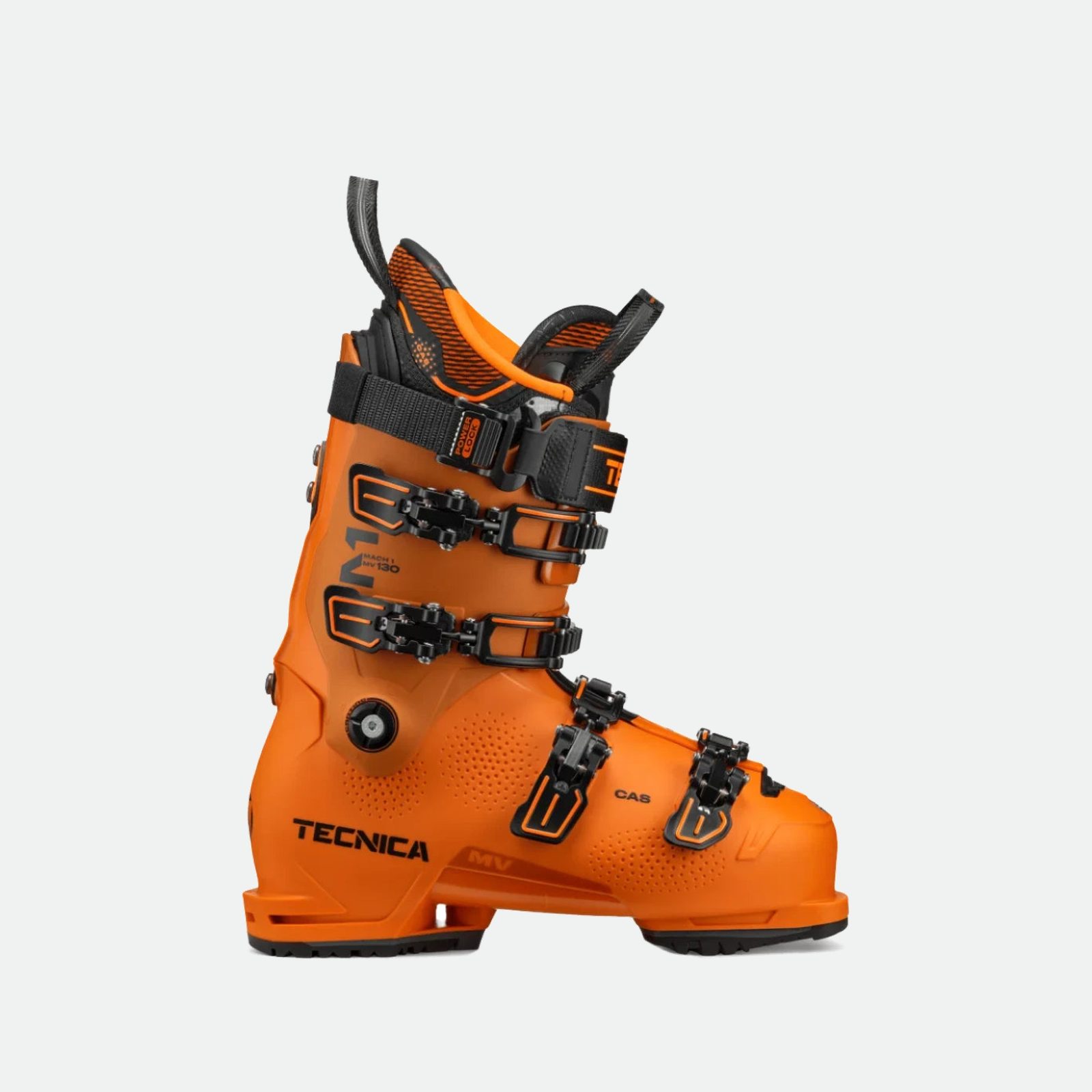
The number stamped on the cuff of a ski boot, 90 or 110 or 130, is its flex index. It describes one thing: how hard the boot is to bend forward at the ankle when you press your shin into the tongue. A low number gives way easily. A high number pushes back. That is all it claims.
The number is not a measurement. Each manufacturer assigns it to rank a boot inside its own line, and there is no test that every brand runs, so a 110 from one brand and a 110 from another are not the same boot. Most adult alpine boots fall between 60 and 150. Junior boots start around 30. Read the number as a position inside one brand's range first and as a rough comparison across brands second.
One thing it is not: a width. Boots are also sold as low, medium and high volume, and those letters describe the shape of the shell around your foot, not how stiff it is. Two different specs, two different problems.
Ski boot flex chart
Flex by ability, for men, women and juniors. Ranges, not rules.
| How you ski | Men's flex | Women's flex | Junior flex | How it feels |
|---|---|---|---|---|
| First time on skis | 60 to 70 | 40 to 60 | 30 to 50 | Bends with little effort, hard to over-pressure |
| Beginner | 70 to 90 | 60 to 70 | 30 to 50 | Forgiving, easy to stay centered |
| Intermediate | 80 to 100 | 70 to 85 | 40 to 60 | Bends under a deliberate move, holds a turn |
| Advanced | 100 to 120 | 85 to 105 | 60 to 70 | Firm, quick to the edge, needs to be driven |
| Expert | 120 to 130 | 105 to 115 | 70 to 90 | Little give, precise at speed, unforgiving when tired |
| Racing | 130 to 150 | 115 to 140 | 90 to 110 | Stiff by design, built for a gate course |
Assembled from four published shop guides, which do not agree with each other. Flex is not standardized, so read these as a starting range and expect a brand's own numbers to sit above or below them.
What flex ski boot do I need?
Find the row for how you actually ski rather than how you would like to, then move inside that range with your weight. Ability sets the range because a boot you cannot bend will not let you get forward on the ski, and a boot you flatten in the first turn will not hold an edge. Weight moves you within it, since a 140 pound skier and a 200 pound skier put very different force into the same cuff.
Starting flex by weight
A weight-only starting point, before ability. Use it to move inside your range in the chart above, not instead of it.
| Skier weight | Men's starting flex | Women's starting flex |
|---|---|---|
| Under 120 lb | 60 | 50 |
| 120 to 140 lb | 80 | 70 |
| 140 to 165 lb | 90 | 80 |
| 165 to 185 lb | 100 | 90 |
| 185 to 205 lb | 110 | 100 |
| 205 to 230 lb | 120 | 110 |
| Over 230 lb | 120 and up | 110 and up |
One shop ladder, women's set ten below men's at the same weight. A race shop's chart runs stiffer again.
Height and how hard you ski shift it again
A tall skier has more leverage over the cuff than a short one at the same weight, and a skier who skis 60 days a year on hard snow wants more boot than one who skis six. Race charts run stiffer than everything above, because a gate course loads a boot in a way a groomer never does.
If two rows fit you, take the softer one. A boot slightly softer than the chart still skis. A boot too stiff to bend stops you skiing at all once your legs are tired and the temperature drops.
Why is a 120 in one brand softer than a 120 in another?
Because the number is a label, not a standard. Every guide worth reading says the same, and it is the reason a chart alone cannot finish this decision.
What actually sets the stiffness is the build. The grade of plastic in the shell, how thick the walls are, how tall the cuff is, how the buckles and the strap pull it closed, and how dense the liner is. Width matters too: a wide shell and a narrow shell carrying the same number rarely feel the same, because there is more plastic to move and more room for your foot to move inside it.
So the number gets you to the right shelf. Your foot in the boot decides the rest.
What does a stiff boot feel like compared to a soft one?
A soft boot lets your ankle bend. It is easier to stay centered, it forgives a late move, and it does not send every ripple in the snow up your leg. It also runs out of support when you push hard, and you feel that as the boot folding under you.
A stiff boot barely moves. It puts pressure on the edge sooner and holds it at speed, and it rewards a skier who drives the front of the boot deliberately. Get it wrong and it stands you upright, throws your weight back, and beats you up by lunchtime.
The shop test is simple. Buckle the boot in a warm room, stand up, and press your shin forward. If you can drive your knee out over your big toe and feel the boot push back, the flex is workable. If nothing moves, it is too stiff. If you flatten it, it is too soft.
Does cold weather make ski boots stiffer?
Yes, and it is not in your head. Boot plastic gets firmer as it gets colder, and how much depends on what the shell is made of. Some boots barely change. Others feel like a different boot at 10 degrees than they did in the shop.
This is why you buy at the softer end of your range rather than the stiffer, and why a boot flexed on a warm shop floor is the easiest boot you will ever feel in that shell.
Can you change the flex of a ski boot?
A little. Some boots are built with a bolt, a screw or a spine at the back of the cuff that can be repositioned or removed to soften or stiffen them slightly, and the boot's own spec sheet says whether yours is one of them. Salomon's race boot, for example, uses a spine held by two screws.
Slightly is the honest word. Nothing changes a 130 into a 100. If a boot is the wrong flex for you, the fix is a different shell.
What flex do junior ski boots come in?
Junior flexes run from about 30 to 110, and most junior boots we fit are numbered the same way adult boots are. Lange's RSJ line is sold as a 50, a 60 and a 65, with the 50 aimed at skiers eight and under and the 60 and 65 at twelve and under, on a junior shell built around smaller calves. Above those sit boots like the Head Raptor 60 and 65, the Lange RS 70 and 90 short cuff, and the Nordica Promachine 90.
Some junior boots carry no flex number at all and use a name and a size range instead. That is normal. For a child, fit and warmth matter more than stiffness, and a young racer gains more from a boot that fits than from a stiffer one.
How Surefoot picks your flex
Every fitting starts with a 3D scan of both feet, which gives your fitter length, width and arch in millimeters. That, plus what you tell us about how and where you ski, is how the shell is chosen from over 100 models, and flex is one of the things chosen with it rather than off a chart. You flex the boot on the shop floor before anything is built.
A custom orthotic milled from your scan holds the foot in a neutral position, and a custom liner is foam-injected around your foot while you stand in the shell, solid in five minutes, with no break-in. Both are options at any fitting rather than requirements. A fitting takes a little over an hour and the boots go home with you the same day, at any of our 29 stores.
Fitted in store
Flex it on the floor, not on paper
Pick a store, pick a time. A fitting with a custom liner and orthotic takes a little over an hour, and the boots go home with you the same day.
Questions
What does flex mean on a ski boot?
Flex is the number printed on the cuff, usually somewhere between 60 and 150 on an adult boot. It tells you how hard the boot is to bend forward at the ankle when you press your shin into the tongue. A low number bends easily and forgives a late move. A high number resists, holds an edge at speed and asks to be driven. It is not a width and it is not a size, and it is assigned by the manufacturer rather than measured to a common standard.
What flex ski boot do I need?
Start from how you ski. A men's boot is usually 70 to 90 for a beginner, 80 to 100 for an intermediate, 100 to 120 for an advanced skier and 120 to 130 for an expert. Women's numbers sit roughly ten lower at each step. Then move inside that range with your weight, since a lighter skier cannot load a stiff cuff and a heavier one flattens a soft one. If two ranges fit you, take the softer. A boot you can bend all day beats one you can only bend in the shop.
Are ski boot flex ratings the same across brands?
No. There is no industry test that every manufacturer runs, so each brand rates its own boots to rank them within its own line. A 120 from one brand can feel noticeably softer or stiffer than a 120 from another, and the difference comes from the grade of plastic, the thickness of the shell, the height of the cuff, the buckles and the liner. Use the number to get to the right shelf, then flex the actual boot before you decide.
Is a 120 flex too stiff for an intermediate?
It can be, and it depends more on your weight and your leverage than on the label. A 120 sits at the advanced end of most charts, so a lighter intermediate will struggle to bend it and will end up standing upright with their weight back. A heavier or taller intermediate who skis hard may be entirely at home in one. The honest test is on the shop floor. If you cannot drive your knee out over your big toe in a warm room, it is too much boot.
What is the difference between a 120 and a 130 flex ski boot?
About one step, and usually one price point. The 130 resists more, holds an edge harder at speed and gives less when you are tired or cold. In most lines the two boots share a shell and differ in the plastic, the cuff or a spine at the back. Because flex is not standardized, a 130 in one brand can sit where another brand's 120 does. Most recreational skiers, including strong ones, are better served by the 120.
How do I know if my ski boots are too stiff?
The tell is that you cannot get forward. You find yourself standing tall, your weight drifts onto the tails, and the ski wants to run away from you at the end of the turn. Your shins get sore from bracing rather than flexing. It usually gets worse late in the day and worse again on a cold morning, because boot plastic firms up as it gets colder. If you cannot bend the boot in a warm room, it will not bend on the hill.
What flex ski boot should a woman ski?
Women's boots are generally rated about ten below men's at the same ability. A beginner is usually 60 to 70, an intermediate 70 to 85, an advanced skier 85 to 105 and an expert 105 to 115, with race boots above that. A 105 is a strong all-mountain and expert number rather than a starting point. Weight and height move you inside those ranges, and a taller or heavier skier will want the upper end of hers.
What flex are kids' ski boots?
Junior flexes run from about 30 up to 110. Lange's RSJ boots are sold as a 50, a 60 and a 65, the 50 for skiers around eight and under and the 60 and 65 for twelve and under. Above them sit junior race boots in the 70 to 110 range. Plenty of small children's boots carry no flex number at all and use a name and a size range instead. For a growing skier, a boot that fits and stays warm matters more than a stiff one.